



Defense Mechanisms
Defense mechanisms are primarily unconscious responses that allow people to protect themselves from anxious thoughts, strong feelings or emotions, unwanted impulses, or painful memories. They are neither good nor bad. Defense mechanisms provide a way to navigate painful memories or hurtful experiences or channel thoughts and energy more productively. They can also cause people to avoid difficult things or relate in unhealthy ways.
One study found that more than 25% of people use at least one defense mechanism to cope with uncomfortable thoughts, emotions, or memories. The study also found that using one defense mechanism makes you more likely to use others.
Types of Defense Mechanisms
People use many defense mechanisms to avoid uncomfortable thoughts, emotions, memories, and impulses. Here are the most common types:
- Regression: Changes in your behavior to earlier stages of development (e.g., children returning to bedwetting or thumb sucking following a stressful or traumatic event)
- Repression: Unconsciously block uncomfortable or painful memories or emotions related to a traumatic or stressful experience
- Suppression: Consciously block out painful or uncomfortable emotions.
- Humor: Make jokes or use humor to deflect negative or uncomfortable emotions
- Intellectualization: Overanalyze an uncomfortable or painful situation rather than acknowledging emotions (e.g., getting a cancer diagnosis and learning everything you can about the disease rather than processing what it means or how it makes you feel)
- Projection: Attribute your poor choices or behavior to someone else or an external force rather than acknowledging where you may have made a mistake
- Rationalization: Justify your behaviors and choices with a rational explanation
- Avoidance: Avoid people, places, or things that bring about uncomfortable thoughts and emotions
- Compensation: Focus on achievement in one area to make up (or compensate) for struggles, inadequacies, or perceived inadequacies in other areas
- Denial: Dismiss or deny reality and focus on internal explanations or mistaken beliefs to avoid uncomfortable realities
- Displacement: Transfer emotional reactions from one situation to another (e.g., having a bad day at work and taking it out on family members)
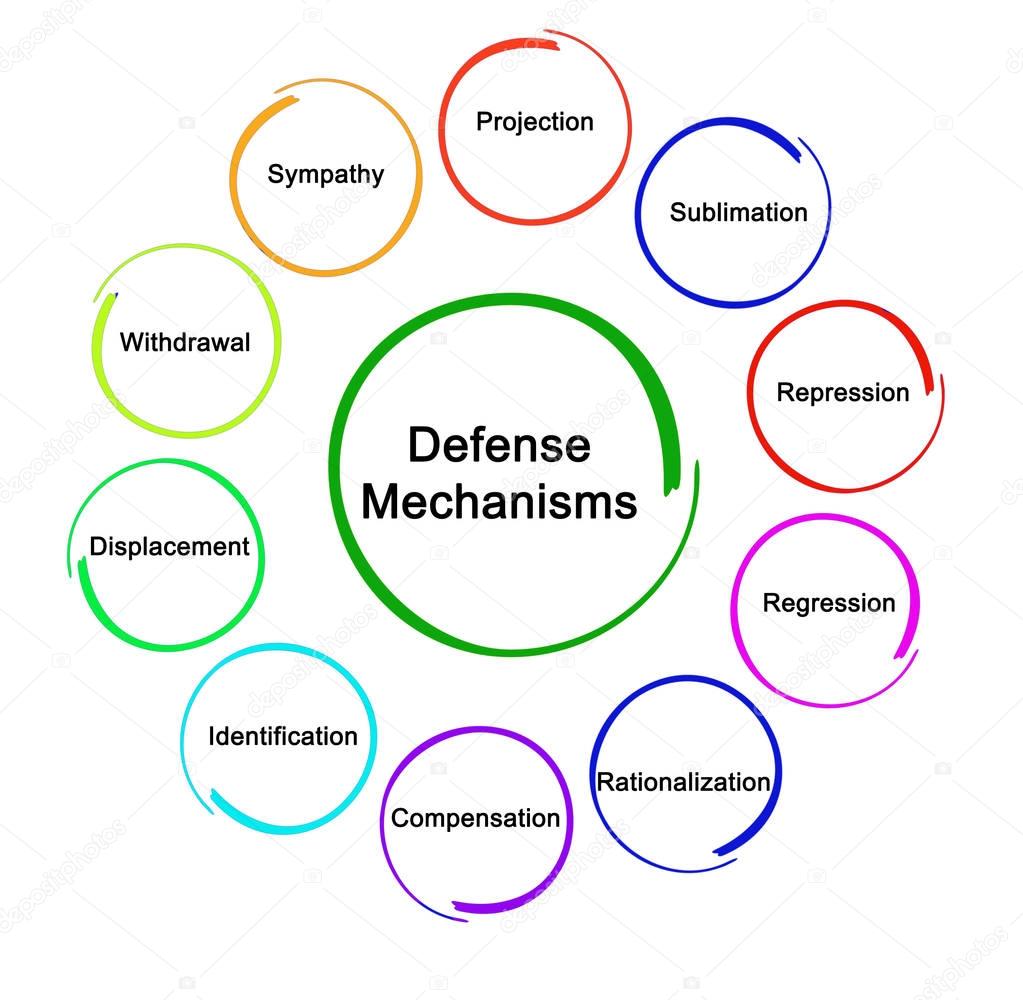

Other Types
Other defense mechanisms are sometimes related to a mental health condition. These defense mechanism tend to occur less often and can include:
- Sexualization: Sexualize people, places, or things or developing fetishes
- Splitting: Characterized by all-or-nothing thinking (common in those with borderline personality disorder, a mental health condition that causes long-term patterns of unstable moods, difficulty maintaining relationships, and turbulent emotions)
- Sublimation: Channel an emotion into something more acceptable (e.g., channeling aggression into playing sports)
- Identification: Copy the behavior of another person without realizing it
- Isolation of affect: Avoid emotions by speaking about things from a factual point of view (e.g., describing the facts of a car accident rather than your emotional experience of it)
- Reaction formation: Use an emotion opposite to the one you feel (e.g., picking on someone you like instead of showing affection)
- Schizoid fantasy: Retreat to your imagination to avoid something uncomfortable (often present in schizoid personality disorder, a mental health condition marked by feelings of disinterest toward other people and social isolation)
- Anticipation: Anticipate problems or challenges ahead of time and tend to overprepare for them
- Conversion: Shift psychological distress into physical symptoms (common in conversion disorder, a mental health condition)
Why People Use Defense Mechanisms
Sigmund Freud first developed the concept of defense mechanisms, which his daughter Anna Freud later conceptualized. She described 10 defense mechanisms: denial, displacement, intellectualization, projection, rationalization, reaction formation, regression, repression, sublimation, and suppression.
Other researchers later added other types of defense mechanisms to the list. One study listed 30 defense mechanisms. Defense mechanisms help people, particularly mental health professionals, understand human development and psychological functioning.
Defense mechanisms can be protective or destructive. People often use them to decrease overwhelming thoughts and feelings related to internal conflicts, outside stressors, trauma, and other situations often beyond their control.
Pros and Cons
Defense mechanisms are often automatic responses to internal and external stress, emotional conflict, and sometimes even trauma. Depending on the person and the situation, they can be helpful and harmful. For some people, a defense mechanism can help build resilience, increase focus, and offer protection from emotional stress. Defense mechanisms can instead be harmful if they keep you from facing reality or lead to self-deception.
Sublimation can be a helpful defense mechanism if you distract yourself when you feel emotionally overwhelmed or anxious by doing something constructive (e.g., reading a book, cleaning a room, making art, or cooking a meal).
On the other hand, displacement can be an unhelpful defense mechanism if you take your anger out on your family because you had a bad day at work.
Here are some possible pros and cons of defense mechanisms.
| Possible Pros | Possible Cons |
|---|---|
| Channel strong emotions | Repress or suppress emotions |
| Reduce effects of painful thoughts/memories | Negatively affect mental health |
| Help protect from trauma/stressors | Lead to self-deception |
| Redirect the mind | Negatively affect relationships |
| Help maintain self-esteem | Disrupt problem-solving |
| Provide a way to cope | Lead to unhelpful thought processes |
Recognizing the Signs of Defense Mechanisms
Because people can use defense mechanisms without knowing, you may not always be aware that you are using them. Likewise, family or friends may not realize when they are using them. For this reason, knowing what defense mechanisms look like is helpful. Recognizing the signs can help you make sense of certain behaviors. It’s also the first step in finding other ways to process uncomfortable thoughts, feelings, and situations.
Here are some behaviors you may notice from someone using defense mechanisms.
| Defense Mechanism | Signs and Examples |
|---|---|
| Humor | Use humor more than what is normal or at inappropriate times |
| Avoidance | Try to escape uncomfortable thoughts, feelings, or situations through drinking, eating, shopping, or another activity |
| Projection | Blame others or not take responsibility for the outcome of different situations |
| Suppression | Withdraw emotionally from uncomfortable or intense conversations, avoid vulnerability, or shy away from emotional intimacy |
| Intellectualization | Overthink things or discuss emotions on an intellectual level rather than feeling them |
| Compensation | Feel like a failure or misfit and try to make up for it in some way |
| Denial | Refuse to accept or acknowledge reality and living as if it’s not true |
| Displacement | Have angry outbursts that are misplaced and confusing for the person on the receiving end |
| Rationalization | Believe that poor choices or inappropriate behaviors are justified given the circumstances |
| Regression | Experience or resort to immature behaviors that are not appropriate for an adult |
Coping
People are typically unaware that they are using defense mechanisms, especially because most are an unconscious response to stressors.
If you notice that you struggle with your relationships or have difficulty accessing authentic emotions when something uncomfortable happens, you might be using defense mechanisms.
If you want to use defense mechanisms less often and learn alternative ways of communicating and processing challenges as they occur, the first step is learning to identify them. Once you know you use them, you can learn other ways of processing difficult thoughts and feelings.
Practice Self-Compassion
Learning to be compassionate with yourself might reduce your need for some defense mechanisms. Research shows that self-compassion can lead to improved well-being, lower levels of depression, reduced stress, and less internal distress.
Be Open To Input From Others
Defense mechanisms are often unconscious, so you may not know when you use them. However, friends, family members, and even therapists may be able to point them out. Try to remain open to listening and making changes.
Learn New Coping Skills
A therapist can help you learn new coping mechanisms like meditation and mindfulness. You can also learn to shift your thought patterns.
Cognitive behavior therapy (CBT) focuses on identifying and exploring unhelpful thought patterns and behaviors and replacing them with more helpful ones. Research shows CBT can eliminate avoidant and safety-seeking behaviors.
Build Self-Esteem
Feeling more confident in your abilities to handle life’s challenges may reduce your need for defense mechanisms. Research suggests that higher self-esteem can act as a protective factor against stressful life events.
When To Seek Care
Getting therapy from a mental health professional can help you stop using defense mechanisms and provide you with the skills to live a healthier and more productive life. Research shows that around 75% of people who enter therapy will benefit.
The key is knowing when you might benefit from therapy.
You may benefit from therapy if defense mechanisms affect your quality of life, job, or relationships. Likewise, if the thoughts, feelings, emotions, or past trauma you are avoiding causes you distress, it may be valuable to work through them with a therapist.