


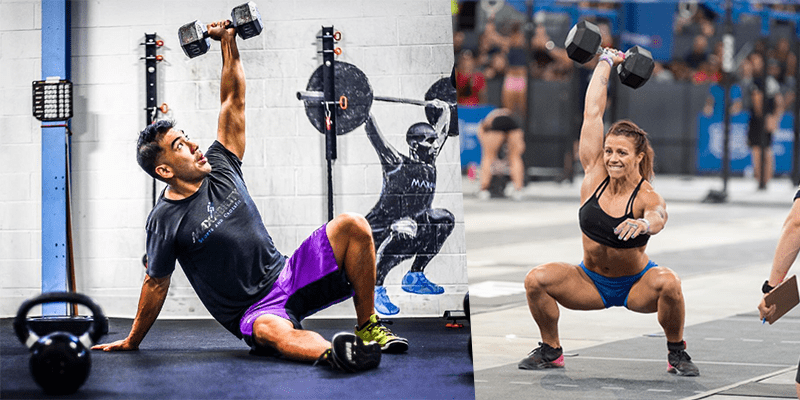
CrossFit Exercise
CrossFit Exercise offers a functional strength-training program that enhances overall fitness. It includes warm-ups and cooldowns in every session.
How Does It Work?
CrossFit refers to functional movements as “workouts of the day” (WOD).
WODs are typically part of a one-hour session that also includes a warm-up, strength or skills work, and a cooldown or mobility
A CrossFit routine may look like the following:
- Warm-up: 2-3 rounds of 3-5 dynamic stretches (e.g., butt kicks, leg swings, or walking lunges), 5-15 reps each
- Strength or skill: Six sets of three power snatches, or lifting a weighted bar over your head while partially squatting
- WOD: As many reps as you can complete in 18 minutes of a 400-meter run, 30 sit-ups on a glute-ham developer (GHD) machine, 20 box jumps, and 10 power cleans
- Cooldown: A few minutes of slow walking and stretching your muscles.
Keep in mind that CrossFit is not a franchise but an affiliate. Each gym, which is known as a “box,” is unique.
Warm-Up
The warm-up prepares your body for the WOD.
Warming up your body before any workout prepares your muscles to receive oxygen by dilating your blood vessels. It allows you to maximize your full capabilities during your workouts by increasing the temperature of your muscles.
Strength or Skill
The strength component can take different forms.1 You might complete multiple sets of the maximum weight you can deadlift.
A skill workout helps improve your ability to do a specific exercise. Examples include double unders—swinging a jump rope under your feet twice—or handstand walking.
The skill you choose makes an appearance during the WOD.
Workout of the Day
The WOD—also sometimes called metabolic conditioning or a “metcon”—is the main part of a CrossFit session. You combine exercises that last for a set amount of time or until you complete a set of repetitions.
There are many possible WODs. You probably will not embark on the same one more than once at the gym. Most WODs last 5-15 minutes if you are used to 60 minutes of non-stop movement in your favorite boot camp. Anything longer than this is known as an endurance WOD.
A few benchmark workouts help track your progress and qualitatively show any improvements over time. A benchmark workout may look like a 20-minute AMRAP (as many rounds as possible).
You would complete a set, such as five pull-ups, 10 push-ups, and 15 air squats, as many times as you can in 20 minutes. Some benchmark workouts are known as “hero workouts,” which are named in honor of fallen service members.
Cooldown
A typical CrossFit session ends with a cooldown or mobility session. You will stretch after the high-intensity part of the workout. You may do a series of forearm stretches after a “grippy” workout, like pull-ups or jumping rope.
Stretching after working out prevents lactic acid from building up in your muscles. Lactic acid build-up often leads to muscle cramping.
CrossFit vs. Bodybuilding
CrossFit contains a strength-building component, but it’s different from bodybuilding.
The main focus of CrossFit is a combination of strength and functional movements. Bodybuilding is generally for competitive purposes.
Bodybuilders train to build muscle mass and reduce body fat. They may enter competitions where judges assess components like their amount of body fat, as well as muscle size and symmetry.
What Are the Benefits?
CrossFit offers benefits beyond helping you get stronger.
“Whether your fitness goal is to help you maintain your current fitness level, get just 1% fitter, lose weight, do a pull-up, or be able to lift a certain weight, CrossFit can help you reach it,” Kyra Williams, a professional CrossFit athlete and personal trainer, told Health.
Can Support Heart Health
One of the health benefits of CrossFit training includes optimizing your cardiovascular endurance.2 Similar high-intensity training, like high-intensity interval training (HIIT), also improves cardiovascular endurance and lowers heart disease risk.
High-intensity exercises can be dangerous for some people with heart disease. Proper cardiovascular screening is important if you have multiple heart disease risk factors.
Helps Build Community
There’s also a community aspect of CrossFit. You could do a workout yourself, but part of the magic happens inside the box.
“There is just something that happens when you get like-minded people in the same room. You lift each other up. You become a family,” Clint Fisher, coach, co-owner, and general manager of CrossFit Charleston, told Health.
Who Is It For?
People of any gender and age, at any stage, can do CrossFit.
“We have former football players working out with people in their 70s and 80s and new moms,” Dave Lipson, CrossFit Level Four Trainer and founder of an educational fitness platform called ThundrBro, told Health.
CrossFit sessions also appeal to people of all ages and fitness levels. Every WOD has suggested weights and movements.
Most CrossFit boxes promote a practice called scaling, which allows you to complete the same workout by altering the weights and movements based on your ability to produce the same intensity level.
CrossFit. Frequently asked questions.
Suppose a WOD calls for 50 repetitions of toes-to-bar, or touching your toes to your hands while hanging from a pull-up bar. The coach might ask one person to scale the repetitions to 25 while another touches their knees to their elbows.
How Can You Get Started?
Check the official CrossFit affiliate map to find a box near you, then do some research.
“Most gyms will have the coaches’ credentials on their website. The more certifications and accolades, the better,” Tony Carvajal, a professional CrossFit athlete, told Health.
But credentials are not everything. Other important things to look for in a CrossFit coach include:
- Communication skills
- Emphasis on form and safety in class
- Leadership style
Don’t be afraid to shop around to find your perfect box. “Every box has a different community and vibe,” mentioned Lipson.
Try out multiple CrossFit spaces to see which one fits best. The only real way to know if you like CrossFit is to try it.
Is CrossFit Safe?
CrossFit is generally considered safe.12 There is the risk of injury when you participate in CrossFit, as with any exercise.
Risk factors include:
- Gender
- Length of training sessions
- Training experience
Ensure you warm up before physical activity. Isometric exercises, which are non-moving exercises, have been shown to prevent injuries. Avoid training if you have acute pain, which can make previous injuries worse.