


Causes of Knee Pain After Working Out
Causes of knee pain after working out, knee pain after working out often follows activities like running, jumping, or kneeling. It may signal overuse, injuries like ligament tears, runner’s knee, bursitis, or osteoarthritis.
1. Runner’s Knee
Runner’s knee, or patellofemoral pain syndrome (PFPS), is an overuse injury affecting the knee joint. Runner’s knee often causes a tender or grating sensation. Knee pain may worsen after climbing stairs, getting up from a chair, running, sitting for long periods, and squatting.
Runner’s knee is one of the most common overuse injuries, affecting about 13% to 30% of runners. People often develop runner’s knee when they change their running mileage or speed or start doing more hill training than usual. Others may develop runner’s knee after surgery or trauma to the knee. Poor nutrition, sleep, and stress may contribute to the injury. People generally recover from runner’s knee, but it may take a while. About 40% of people still have symptoms after one year of treatment.
Runner’s knee treatments include:
- Exercising your hip and knee
- Icing your knee
- Modifying your workouts
- Taping your knee
- Using nonsteroidal anti-inflammatory (NSAID) drugs to relieve pain
2. Infection
Infectious arthritis happens if bacterial, viral, or fungal infections from other body parts spread to your knees, causing pain.
Reactive arthritis is infectious arthritis that occurs when your joints, such as your knees, react to an infection in your body. For example, your knees may react to a urinary tract infection (UTI) or vaginal infection.
Other infectious arthritis symptoms include:
- Chills
- Difficulty moving the affected joint
- Fever
- Red, swollen joints
A healthcare provider will likely test your blood, joint fluid, and urine for signs of infectious arthritis. Treatments typically include medicines and surgery.
3. Fractured Kneecaps
Although uncommon, car accidents or falls may result in a fractured kneecap. You may feel pain near the front of your knees.
Other symptoms of fractured kneecaps include:
- A build-up of fluid in the affected area
- Feeling unstable
- Tenderness to the touch
- Trouble climbing stairs
- Weakness
A healthcare provider will place your knee in a brace or cast and advise you to limit your activities for four to six weeks. You may require surgery if your fracture is severe.
4. Meniscus Tears
A meniscus is a cushion of cartilage in your knees that absorbs shock. A meniscus can tear if you kneel, squat while lifting something heavy, or twist your knee. Getting hit and quickly changing directions while moving may tear a meniscus.
6 Health Benefits of Wearing a Weighted Vest While Walking
Meniscus tear symptoms include:
- Locking of your knee
- Pain that gets worse if you put pressure on your knee or walk
- Swelling the day after the injury
5. Strains and Sprains
An abrupt and unnatural twisting of muscles causes strains and sprains.
Strains, or pulled muscles, are muscle tears. Excessive physical activity, improper warm-up before exercise, and poor flexibility cause strains. Sprains are ligament injuries that may occur from excessive stretching or tears.
Common strains and sprains symptoms include:
- Bruising or discoloration of the skin
- Difficulty moving your muscle
- Joint stiffness
- Pain
- Swelling
Both strains and sprains are minor injuries. Warming up properly before exercise can help prevent them.
6. Ligament Tears
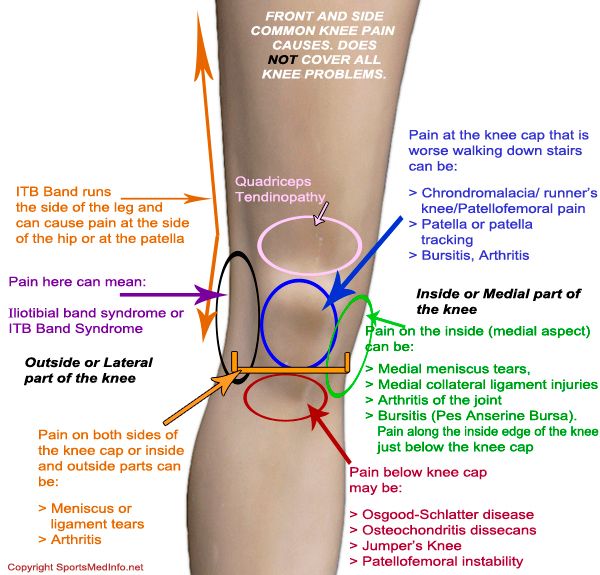
Ligaments are tissues that connect bones. The anterior cruciate ligament (ACL) and medial collateral ligament (MCL) can tear and cause instability, pain, and swelling. The ACL runs in the middle of your knees. The MCL, located on your inner knees, prevents them from bending inward. The ACL and MCL are the two most commonly injured ligaments of the knee, though you can also tear your posterior cruciate ligament (PCL) or lateral collateral ligament (LCL).
Symptoms of ligament tears in the knee include:
- A loud popping sound at the time of injury
- Feeling unstable (e.g., your knees may shit from side to side if you have an MCL tear)
- Pain
- Swelling, typically within six hours of an ACL injury
ACL and MCL injuries typically occur among basketball, football, soccer, and skiing athletes. You may tear your ACL or MCL if you get hit during a tackle, overextend your joint, and quickly stop moving and change directions.

11 easy fitness resolutions you’ll actually stick to in 2026
7. Bursitis
Bursitis causes pain in the front of your knee if a bursa becomes irritated and swollen. A bursa is a fluid-filled sac that cushions and protects your bones, muscles, and tendons.
Inflammation may occur due to injury, overuse, or repeated pressure, such as kneeling. Changes in activity level (e.g., training for a marathon), infections, and some types of arthritis may cause bursitis.
Bursitis symptoms include:
- Pain and tenderness when you press on your knee
- Pain around your knee
- Pain while moving and resting
- Redness, swelling, or warmth
- Stiffness while moving
8. Iliotibial Band Friction Syndrome
Overuse causes iliotibial band friction syndrome (ITBFS), a knee joint injury. ITBFS occurs when your iliotibial (IT) band, a tendon along the outside of your leg, rubs against the bone, typically when you bend. As a result, your IT band becomes irritated and swollen. You may feel pain in your lateral (outer) knee.
ITBFS commonly affects 1.6% to 12% of athletes like:
- Basketball, hockey, or soccer players
- Cyclists
- Long-distance runners
- Skiers
You might develop ITBFS if you do not warm up before exercising. ITBFS symptoms first appear when you start exercising and get better after you warm up. As ITBFS progresses, you may feel pain after warming up. Bending your knee while sitting or running down a hill worsens pain.
9. Jumper’s Knee
Jumper’s knee—also called patellar tendinitis, patellar tendonitis, or patellar tendinopathy—is a knee joint injury. As the name suggests, you can develop jumper’s knee after strenuous jumping, often from playing basketball or volleyball. Long-distance running and skiing may result in jumper’s knee. Jumper’s knee primarily affects athletes aged 15–30.6 People with jumper’s knee typically have pain below their kneecap and stiff knees while climbing stairs, jumping, and kneeling. Resting is usually painless.
10. Dislocated Kneecaps
You might dislocate your kneecap if you awkwardly twist or bump your knees. Adolescents most commonly have dislocated kneecaps from playing sports.
Signs and symptoms of a dislocated kneecap include:
- A popping sound when the injury happens
- Extreme pain
- Visible dislocation of the kneecap through the skin
Your kneecap will typically pop back into position. You may need a brace, cast, or splint while limiting your activities for six to eight weeks. Your kneecap may be less stable than usual after dislocating it. As a result, people who dislocate their kneecaps have a high risk of repeating the injury.
11. Osteoarthritis
Knee osteoarthritis (OA) occurs when wear and tear break down your connective tissue (joint cartilage). OA, which happens with overuse, is one of the most common diseases that affect the knees. People typically develop OA as they age. OA affects more than 32.5 million adults in the United States.
Factors that typically worsen knee pain from OA include:
- Having OA for a long time
- Inactivity
- Moving around for long periods
- Repetitive bending
- Using stairs
Changes that limit your motion, stiffness, and swelling may occur. You may have buckling knees and hear a grinding or scraping noise while walking. Consult a rheumatologist if you are worried about OA. A rheumatologist is a healthcare provider who specializes in arthritis and other joint conditions. A rheumatologist may diagnose you with knee pain from a different type of arthritis, such as gout, lupus, or rheumatoid arthritis (RA).