

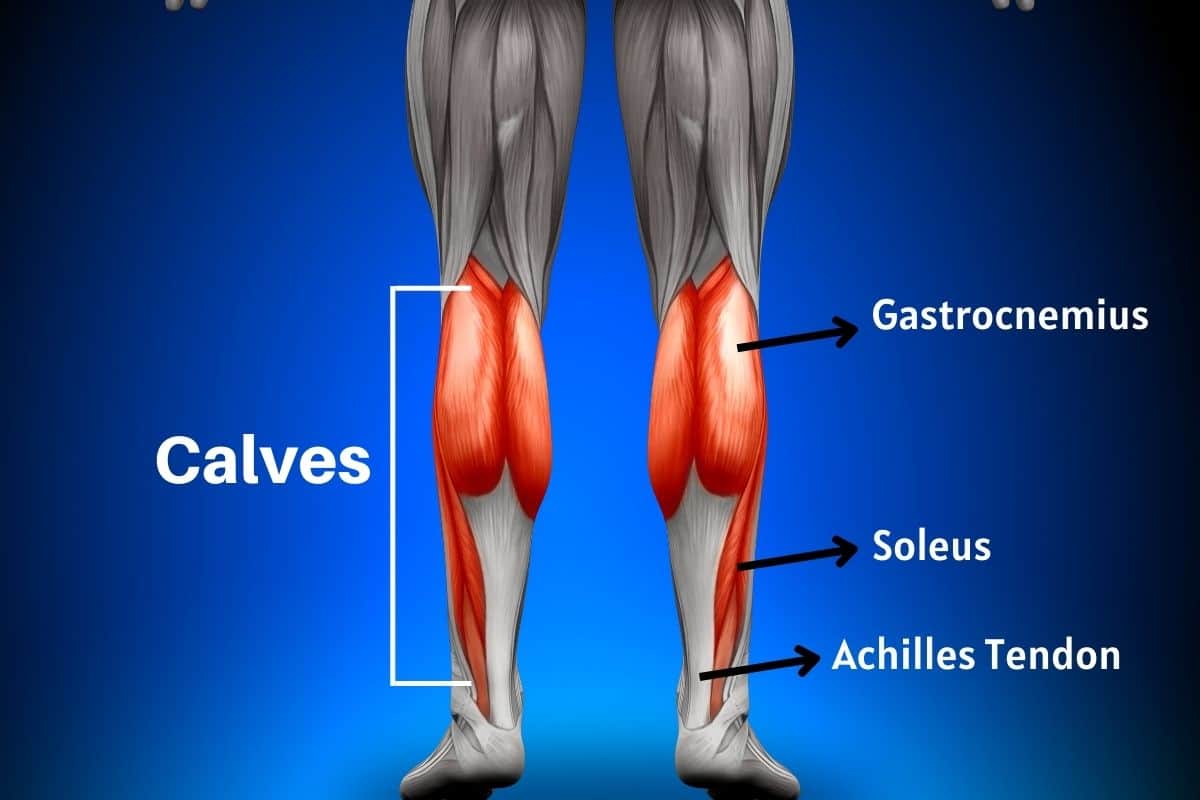
Your Calf Muscles
Your calf muscles are among the largest muscle groups in your body. Located on the back of your lower leg, they are the muscles that are always working when you are on your feet.
For sprints and jumps, your calves are responsible for extending your foot and propelling you forward and upward. For aesthetics, your calf muscles are the finishing touch to your legs, rounding off your leg muscles’ appearance, and always visible when you are wearing shorts or skirts.
In this article, you will learn how to train your calves effectively. From calf muscle anatomy and growth, to the calf exercises that are most effective for making them bigger and stronger. And then we’ll put it all together into one effective calf workout.
11 Potential Causes of Knee Pain After Working Out
Calf Muscle Anatomy
Your calf muscles are called triceps surae, and consists of two muscles:
- Gastrocnemius is the outer, two-headed muscle. It originates from the lower end of your femur (thigh bone).
- Soleus is the inner, one-headed muscle, which originates from the top of your tibia and fibula.
Both muscles come together into the Achilles tendon, which inserts on your heel bone.


Even though the soleus is located below the gastrocnemius, the two muscles are of equal size, and thus both contribute to your calf muscle mass.

The primary function of the calf muscles is to extend your foot. The soleus is one of the postural muscles, which means that it’s always working when you are standing up. Also, both soleus and gastrocnemius are active when you are walking. This means that your calves get a lot of “free” training all day long.
And this shows when you examine the calf muscles closer. Samples from 27 recreationally active females showed that the soleus had 18% larger type I muscle fibers and 19% larger type II muscle fibers than their quad muscles.
This might mean that your calves are already trained to some extent, just from your everyday living and moving around. In turn, this might mean that your calf muscles require more and harder training than your other muscles.
8 Best Exercises To Do a Boxing Workout at Home
Calf Muscle Fibre Type
The calf muscles mostly consist of type I fibers, which are slower than type II fibers but don’t tire as quickly.
While the variation between individuals is large, the average calf fiber type distribution in the general population is something like this:
- Gastrocnemius has about 55% type I fibers.
- Soleus has about 80% type I fibers.
While both type I and type II muscle fibers grow from strength training, type II muscle fibers tend to grow slightly more.
There is, however, not any convincing evidence that muscles should be trained differently based on their fiber type. The same principles still apply: do mostly heavy, low-rep training for strength, and mostly moderately heavy, medium rep training for muscle growth (although muscle growth can be attained with a wide range of reps and loads).
With the calf muscle fiber type and their already trained status taken together, we arrive at a conclusion that many gym-goers and bodybuilders have discovered on their own.
Your Calf Muscles Are Notoriously Hard to Grow
It’s not just your hunch. The research confirms that the calves are harder to grow than many other large muscle groups.
One study had participants perform a hard calf workout consisting of three different calf exercises with 4 sets of 15 reps to failure in each exercise, for 12 sets in total. Afterward, they measured the increase in their rate of muscle protein synthesis (= rate of muscle growth) and found that it was only about a third of what is typically seen in the quads after a workout.
Another study had previously untrained participants train seated calf raises three times per week for eight weeks, doing 4 sets x 9–13 reps to failure each workout. While they increased their calf strength by 13% over these eight weeks, their calf muscles barely grew at all: only a 2.5% increase in muscle thickness.
For calf muscle growth, eccentric overload training seems more promising. Two different studies managed to elicit 9% and 18% muscle growth, respectively, both in 12 weeks.
he first study had participants doing eccentric heel drops, where they did the concentric portion of the exercise with both legs, but lowered themselves down using only one leg. They did 3 sets x 15 reps each workout, and worked out twice daily during all 12 weeks.
The other study had participants train twice per week, doing 3–5 sets x 10 eccentric repetitions of calf raises in a BioDex-machine.
Interestingly, both studies also saw 9–21% increases in muscle fascicle length (a common result from eccentric training), which is beneficial for power and also reduces the risk of muscle strains.
Calf Exercises: The Best Exercises for Building Your Calves
In this section, we’ll take a look at four calf exercises with slightly different benefits and training effects, that also complement each other in terms of which of the calf muscles they target.
By putting them all together, as we’ll do in the next section, you can create a great calf workout.
1. Standing Calf Raise

The standing calf raise is one of the best calf exercises you can do. By standing on straight legs, you ensure that both your soleus and gastrocnemius muscles are trained.
The calf raise machine makes it easy for you to adjust the resistance, and the foot rest allows for great range of motion. Just make sure you are putting the weight on the balls of your feet, and not on your toes.
2. Seated Calf Raise

The seated calf raise differs from its standing counterpart, in that your knee joint is flexed. This shortens your gastrocnemius (which crosses over the knee joint), making it unable to assist much in the exercise. Instead, your soleus muscle does most of the work, and is therefore somewhat isolated in this exercise.
Since you’re sitting down, this exercise often allows for a little more focus on your working muscles, and you might have an easier time finding good contact with your muscles.
3. Heel Raise

The heel raise is similar to the standing calf raise but done without a machine. Of course, you can substitute them for another, but if you are going to train with high reps, the unloaded heel raise often suffices.
A benefit of this exercise (and also the next) is that you can train them anywhere, without equipment. All you need is some kind of elevation to put your feet on, but anything from a stair step to a thick book can be used for that.
4. Eccentric Heel Drop

Last but not least, comes the eccentric heel drop. Based on the previously mentioned studies which saw good muscle growth from eccentric training, you will be training in a similar manner.
Use both legs to extend your feet, but use only one leg in the eccentric portion of the exercise. Repeat for all reps with one side, before you do the same thing with your other leg. Use additional weight, such as a dumbbell, if necessary to reach adequate resistance. Of course, you could use the standing calf raise machine for this purpose as well.
This exercise isn’t only good for training your calves, it is also common for Achilles tendon rehabilitation and strengthening.
Calf Workout for Muscle Growth and Strength
So what does an effective calf workoutlook like?
Building on the exercises above, let’s construct an example workout, drawing on several principles:
- The exercises target both calf muscles: the gastrocnemius and soleus.
- The load and rep range covers a wide spectrum, ranging from medium reps with moderate weights, all the way up to high reps with light weights.
- Eccentric overload is emerging as an effective calf training technique, and you will be incorporating that into this workout.
This workout is aimed at both strength and muscle growth, and you will be able to get good results of both with it.
Let’s have a look at the workout, and then go through why it looks like it does.
Pulsefitn’s Calf Workout
- Standing Calf Raise: 3 sets x 8 reps
- Seated Calf Raise: 3 sets x 15 reps
- Heel Raise: 2 sets x 30 reps
- Eccentric Heel Drop: 3 sets x 10 reps/side